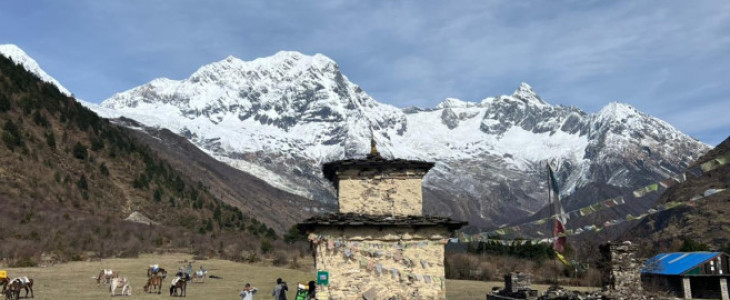
The Short Manaslu Circuit Trek offers an exhilarating journey along one of Nepal’s most stunning off-the-beaten paths. Winding through the Manaslu Conservation Area, this route gradually ascends and descends along the foothills of the majestic Manaslu Himalayas. Along the way, the rich Tibetan-influenced culture and diverse ecosystems provide a truly immersive trekking experience, leading you to the breathtaking Larkya La Pass (5160m). This shorter version of the classic circuit is ideal for adventurers looking to explore the region in less time and with a more efficient itinerary.
The adventure begins with an overland journey from Kathmandu to Soti Khola. Leaving the Kathmandu Valley behind, the drive follows the Prithvi Highway alongside the Trishuli River before continuing along the Budhi Gandaki River to your starting point. From here, the trail gently follows the riverbanks to Machha Khola, gradually gaining altitude en route to Jagat. Entering the edge of Tsum Valley, the trail cuts through the heart of the Manaslu Conservation Area.
As you ascend, Tibetan cultural elements become more prominent, especially around Namrung, where panoramic views of the Manaslu and Ganesh Himal ranges begin to unfold. The trail leads to Samagaon, a traditional Himalayan village, where you can explore local monasteries or opt for acclimatization hikes to Birendra Lake or Pung Gyen Monastery—ideal spots to rest and immerse yourself in the spiritual heritage of the region.
The trek advances to Dharamsala, where final preparations are made for the demanding but rewarding climb to the Larkya La Pass (5160m). From this high vantage point, mesmerizing views of Manaslu, Himlung, and Cheo Himal offer an unforgettable Himalayan panorama. The descent through Bimthang eventually concludes with a drive back to Kathmandu, wrapping up this compact yet rewarding trek.
The Short Manaslu Circuit Trek is perfect for those seeking a rich trekking experience in the Himalayas within a shorter timeframe and moderate budget.
Why Choose Adventure Aspirant?
At Adventure Aspirant, we specialize in crafting exceptional trekking experiences throughout Nepal. Our professional and personable guides and porters are dedicated to making your journey both enjoyable and safe. We provide comprehensive services including transportation, accommodations, and logistics—plus, we offer tailor-made itineraries to suit your personal preferences and travel style.
Trip Highlights:
Discover the biodiversity and landscapes of the Manaslu Conservation Area
Enjoy panoramic views of the Manaslu, Shringi, Cheo, and Himlung Himal ranges
Conquer the Larkya La Pass (5160m)—a challenging and rewarding high-altitude crossing
Experience remote Himalayan culture and traditions shaped by Tibetan heritage
Custom Itineraries & Group Offers
If the standard itinerary doesn’t quite fit your schedule or interests, Adventure Aspirant offers flexible customization options with special group discounts. Reach out to us at info@adventureaspirant.com for detailed information, or speak to us directly at +977-9767232220 for round-the-clock assistance. We are fluent in English, Nepali, and Hindi.
Day 01: Scenic Drive from Kathmandu to Machha Khola (930m) by Private Jeep | 8–9 Hours
Your adventure begins with a drive westward from Kathmandu, tracing the banks of the Trishuli River as you exit the valley. After reaching Arughat, the route continues north, following the Budhi Gandaki River up to Soti Khola. Upon arrival, settle in and enjoy some free time to explore the riverside village.
Day 02: Trek from Machha Khola to Jagat (1300m) | 6–7 Hours
The trail becomes more demanding as you ascend gradually toward Jagat. Along the way, pass through Khorlabensi and enjoy a relaxing stop at Tatopani, famous for its natural hot springs. Soak your feet and relax before continuing through Dobhan to reach Jagat, an entry checkpoint for the Manaslu Conservation Area.
Day 03: Trek from Jagat to Deng (1860m) | 7–8 Hours
After breakfast, the path leads north past Salleri and down to Sirdibas, before climbing again to the sizable village of Philim. Continuing through Ekle Bhatti, the scenery becomes increasingly remote and rugged. You end the day in the quiet hamlet of Deng, surrounded by forested hills.
Day 04: Trek from Deng to Namrung (2540m) | 5–6 Hours
Leaving Deng behind, you officially enter the Manaslu Conservation Area. Permits are checked at the post, and you proceed past Rana and other small villages. The path leads through Ghap, then climbs through forested ridges and across wooden bridges before reaching Namrung, a scenic viewpoint village.
Day 05: Trek from Namrung to Samagaon (3390m) | 6–7 Hours
Wake up to views of Ganesh Himal and Himal Chuli. The trail meanders past Lihi and Lho, offering captivating glimpses of Mt. Manaslu (8163m). As Tibetan influence increases, you'll notice changes in architecture, prayer wheels, and monasteries. Eventually, arrive in Samagaon, a culturally rich village ideal for mountain gazing and exploration.
Day 06: Acclimatization and Exploration in Samagaon
Spend a full day acclimatizing and discovering the local culture. Visit Pung Gyen Monastery or hike to Birendra Lake, a glacial gem beneath Mt. Manaslu. For seasoned trekkers, an optional side trip to Manaslu Base Camp (4400m) offers a thrilling adventure and excellent altitude training.
Day 07: Trek from Samagaon to Dharamsala (4460m) | 7–8 Hours
Today’s trail follows the upper Budhi Gandaki to Samdo, a windswept Tibetan village. Continue past sparse pastures and alpine landscapes before reaching Dharamsala (Larkya Phedi). Nestled below the Larkya Glacier, this high-altitude stop prepares you for the next day's ascent. Basic mountain lodges are available for overnight stay.
Day 08: Trek from Dharamsala to Bimthang (3590m) via Larkya La Pass (5160m) | 8–9 Hours
A highlight of the trek awaits as you scale the Larkya La Pass, one of Nepal’s highest and most scenic mountain passes. Ascending along the glacier, panoramic views of Manaslu, Cheo Himal, Himlung, and Annapurna II open up. After reaching the pass, descend through rocky terrain to arrive at Bimthang, a serene alpine meadow.
Day 09: Trek from Bimthang to Dharapani (1960m) | 8–9 Hours
Today involves a long descent, retracing lush forests and farmland. Pass through Sangure Kharka, Kharche, and Tilije, then join the Marshyangdi River near Gho. The trail enters the Annapurna Conservation Area before reaching Dharapani, a popular hub for trekkers finishing their Manaslu or Annapurna treks.
Day 10: Return to Kathmandu (Dharapani to Besisahar by Jeep, then Bus to Kathmandu) | 8–9 Hours
Bid farewell to the Himalayas with a shared jeep ride to Besisahar. Here, you may browse local shops and purchase souvenirs before boarding a public bus back to Kathmandu via the Prithvi Highway. Expect to arrive in the evening, with time to reflect on your unforgettable journey.
Services Provided by Adventure Aspirant:
Services Not Provided by Adventure Aspirant:
Larkya La Pass (5,106 m) – The Highest Point of Manaslu Circuit Trek
Standing at an elevation of 5,106 meters, Larkya La Pass is one of the most challenging and rewarding crossings in the Himalayas. It marks the pinnacle of the famous Manaslu Circuit journey.
This dramatic mountain pass links the Manaslu Conservation Area with the Annapurna Conservation Area. The pass is named after Larkya Peak (6,249 m), which towers over the route.
From the top, trekkers are rewarded with breathtaking views—Mount Manaslu dominates the skyline to the east, while Annapurna II and surrounding giants form a dramatic panorama.
Manaslu Base Camp vs. Manaslu Circuit
The Manaslu Base Camp trek is not a standalone route. Instead, it is a key acclimatization excursion included within the Manaslu Circuit.
This side trip begins from Samagaun (3,520 m) and covers roughly 5 km one way. The round trip usually takes 6–7 hours.
At 4,800 meters, the base camp offers incredible views of the north face of Manaslu. More importantly, it helps trekkers adjust to altitude before attempting Larkya La Pass.
Difficulty of Manaslu Circuit Trek
The trek ranges from moderate to strenuous. Challenges include long walking days, altitude gain, and physical fatigue, making proper acclimatization essential.
About Mount Manaslu
Mount Manaslu rises to 8,163 meters, making it the eighth-highest mountain on Earth. Its name comes from the Sanskrit word manasa, meaning “mind” or “spirit.”
Located in the Gorkha region, it forms part of the Manaslu Himal range near the Nepal–Tibet border.
Notable features include the Larkya Glacier, as well as nearby lakes and ridges that add to its dramatic landscape. The mountain remains a major attraction for experienced climbers.
Head Gear
Multifunctional buff or neck gaiter
Sun cap, wide-brim hat, or headscarf
Lightweight balaclava or insulated wool/fleece hat
UV-protection sunglasses
Headlamp or flashlight with batteries
Upper Body Clothing
Breathable T-shirts or thermal base layers
Warm fleece or insulating jacket
Waterproof and wind-resistant outer shell
Down jacket (bringing your own is highly recommended; Adventure Aspirant Pvt Ltd will provide one on rental basis, which must be returned after the trek)
Lower Body Clothing
Lightweight trekking trousers
Waterproof over-trousers
Thermal base layer bottoms
Footwear
Lightweight liner socks
Thick wool hiking socks for warmth
Sturdy and comfortable trekking boots
Casual shoes, sandals, or slippers for use after trekking
Hand Protection
Insulated waterproof gloves (such as Gore-Tex or similar)
Accessories & Essentials
Sleeping bag suitable for temperatures around -20°C (personal one is recommended; rental available through Adventure Aspirant Pvt Ltd and must be returned after use)
Trekking duffel bag (provided), plus an additional suitcase or bag for storage in Kathmandu
Waterproof covers or plastic liners to keep gear dry
Trekking poles (optional but beneficial)
Reusable water bottle or hydration bladder
Personal toiletries and hygiene items
Quick-dry towel
Basic repair kit (needle, thread, etc.)
Sunscreen, insect repellent, and lip balm
Personal first-aid kit (including pain relievers, bandages, antihistamines, and medication for stomach issues)
Electrolyte or rehydration salts, along with any personal medications
Wet wipes or tissues
Books, journal, or other light entertainment items
1- Can I arrange a private trip with friends or family?
Absolutely. Private Short Manaslu Circuit treks can be organized for families or groups of friends. These trips allow you to move at a pace that suits your group rather than following a fixed itinerary. Even a solo participant can do Manaslu Trek at the moment, and all logistics are handled so everyone in your group is well taken care of.
2- Is it possible to trek the Short Manaslu Circuit independently?
No, independent trekking is not allowed in the Manaslu region. Because it is a restricted area, trekkers must obtain special permits and travel with a licensed guide. These regulations are enforced by the Government of Nepal to maintain safety and protect the region.
3- Can I get a visa on arrival in Nepal?
Yes, most travelers can obtain a visa upon arrival at Tribhuvan International Airport. To make the process smoother, it’s a good idea to fill out the online application form in advance and carry payment (cash or card) for the visa fee.
Make sure your passport is valid for at least six months beyond your arrival date and has at least one blank page for the visa stamp.
4- What happens during the pre-trek briefing in Kathmandu?
Before your trek begins in Kathmandu, you’ll attend a briefing session. During this meeting, you’ll be introduced to your guide, and important documents such as your passport copy and travel insurance will be collected.
Your gear will also be checked to ensure you’re fully prepared. Essential items like a down jacket, sleeping bag, trekking map, and duffel bag are typically provided. This is also a good opportunity to ask questions and clarify any concerns before heading into the mountains.
5- How do I book the Short Manaslu Circuit Trek? Is a deposit required?
To reserve your spot on the Short Manaslu Circuit Trek, you’ll need to complete a booking form with your travel details. Information such as flight schedules and insurance can be submitted later.
A deposit of 15% is required to confirm your booking. Once the payment is received, your trip is officially secured.
6- Will I get a refund if I cancel my trek?
The initial 15% deposit is non-refundable if you decide to cancel your trip, regardless of the reason. However, the amount is not lost—you’ll receive a lifetime credit that can be used toward a future trek.
7- Is there an age limit for the Short Manaslu Circuit Trek?
There is no fixed age restriction for joining the Short Manaslu Circuit Trek. Trekkers of various ages—from young children to seniors—have successfully completed this journey.
What matters most is overall health and fitness rather than age. For safety, younger participants under 16 must be accompanied by a parent or guardian. Special arrangements can also be made to support both older trekkers and families with children.
8- How should I prepare? Is this a technical climb?
Preparation is key for a successful trek. It’s advisable to start training about a month to six weeks in advance. Focus on cardiovascular fitness through activities like hiking, jogging, stair climbing, or brisk walking.
Practicing long walks (5–6 hours) with a backpack will help simulate trekking conditions. Breaking in your boots beforehand is also important to avoid discomfort.
The Short Manaslu Circuit is not a technical mountaineering expedition. It follows well-established trails through villages, forests, and high mountain passes. However, it is physically demanding due to altitude and terrain.
9- Is travel insurance required?
Yes, travel insurance is compulsory for this trek. Your policy should include coverage for high-altitude trekking (up to around 6,000 meters) and emergency evacuation, including helicopter rescue.
Well-known providers include Allianz Travel Insurance, AXA Travel Insurance, and World Nomads, among others.
10- Can I trek during summer or winter?
Trekking during winter (December to February) is generally discouraged due to heavy snowfall and extreme cold, especially near Samdo and Dharamsala. Trails may be blocked, and accommodations can be limited.
The monsoon season (June to August) also presents challenges, including frequent rain, landslides, muddy paths, and poor visibility. Leeches are common in lower elevations during this time.
11- How can I prevent altitude sickness?
To reduce the risk of altitude-related illness, maintain a steady pace, stay well hydrated (around 4–5 liters daily), and eat nourishing meals. Avoid alcohol and follow a proper acclimatization schedule.
If symptoms appear, inform your guide immediately. They will monitor your condition and oxygen levels. In severe cases, evacuation can be arranged.
12- Who carries the luggage?
Porters are available to carry shared bags, typically dividing one load between two trekkers with a weight limit of around 25 kg. You’ll only need to carry a personal daypack with essentials like water, snacks, and valuables.
13- Can I leave extra belongings in Kathmandu?
Yes, you can store additional luggage safely at your hotel in Kathmandu. This allows you to travel lighter during the trek and retrieve your items afterward.
14- Is trekking gear provided?
Basic equipment such as a down jacket, sleeping bag (suitable for temperatures down to around –15°C), a duffel bag, and a trekking map are usually provided. These items help ensure comfort and safety during the journey.
15- Will I receive a completion certificate?
Yes, trekkers are typically awarded a certificate after successfully completing the Manaslu Circuit Trek as a keepsake of their achievement.
16- Is there Wi-Fi or phone connectivity?
Connectivity is available in many areas along the trail. SIM cards from Nepal Telecom (NTC) and Ncell can be purchased in Kathmandu, allowing you to stay in touch during the trek.
17- Can I charge my devices?
Charging facilities are available at most teahouses for a small fee. Costs typically range between NPR 200–500 per device. Since electricity often depends on solar power at higher elevations, carrying a power bank is highly recommended.
18- Are single rooms available?
Accommodation is generally arranged on a twin-sharing basis. If you prefer a private room, it may be possible for an additional fee, depending on availability.
19- What food can I expect?
Teahouses along the route serve a variety of meals, including Nepali, Indian, Chinese, and some Western options. Meals are freshly prepared and designed to provide enough energy for trekking.
20- Are special diets accommodated?
Yes, vegetarian, vegan, and gluten-free options are widely available. It’s important to inform your guide in advance about any dietary needs or allergies so proper arrangements can be made.
21- Can I customize my itinerary?
Yes, the itinerary can be adjusted to suit your preferences—whether that means adding rest days or including visits to places like Pokhara or Chitwan National Park.
Customization is typically offered for private trips rather than fixed group departures.
The given cost are per person and exclude international flights. Given below are the departure dates available for online booking. If the given date is not favorable then please contact us and we will happily customize your trip on dates more appropriate for you.
Note: If your group size is of more than 1 pax then you can set your own departure date.
| Start Date | Trip Price | Discount | Discounted Price | Action |
|---|
USD1298pp
Duration : 11 Days
From USD 1649
Duration: 17 Days
View Details